

off
Monte Zebio

Military cemetery of the Sassari Brigade, on mount Zebio.
Walking along the Austrian mule-track they arrived where in June 1917 the mine that had changed the face of the mountain and buried the Italian garrison of the Lunetta had exploded. Huge boulders were thrown around and some rolled up to the Pozza delle Arne; in the crater of the explosion there were a few positions for machine guns, and looking through the loopholes you could see the skeletons hanging on the barbed wire. Behind the Crocetta there were caves, pillboxes, excavations, ladders to climb from the trenches. Of what they remembered there was nothing left, not even the outline of the mountain.”
From “L’anno della vittoria” (The year of the victory)
“The Busa del Carbon opened out before us, wide and without light. The great rock steps revolved around like an amphitheatre, and between one and another step, on the ledges, there were black pines; down in the centre, the frozen pond. I felt that the roosters had to be here, so I approached cautiously and ready to shoot (…)
The evening caught us by surprise sitting under a fir tree where we had finished the flask of grappa. Far away, down at the bottom, you could see the town lit up. From the line of lights I guessed the streets and districts. Above the houses the smoke stretched out from the chimneys. The chimneys were smoking: warm homes, steaming milk, potatoes and hot soup, sleepy children. The hunt was over.
From “Il bosco degli urogalli” (The wood of the capercaillies), “Chiusura di caccia” (Hunt Closing).
The context
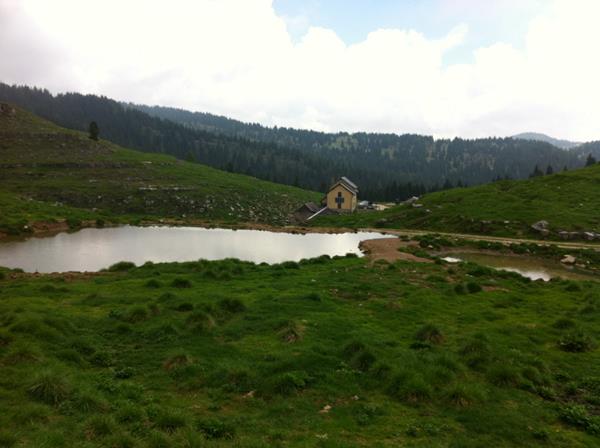
Mount Zebio
The Monte (mount) Zebio is the original core of the Ecomuseum of the Great War, the place where the different phases of the conflict and military strategies are better readable, thanks to a careful restoration of the artifacts and the effective signage. Around the peak heavy fightings took place (also narrated by Emilo Lussu in “A Year on the High Plateau”), which in summer 1916 (after the retreat of the Strafexpedition) and June 1917 (with the attack on Monte Ortigara) saw the Italian army trying in vain to break through the heavily armed Austrian lines.
Among Zebio and Pastorile Rigoni Stern went hunting, and once, he said, on the Zingarella he succeeded to miss a grouse seven times. In the short story quoted, after being down from the mountain with his friend, he unloaded the rifles shooting in the air, in tribute to a flight of twelve grouses that had escaped them.
The route
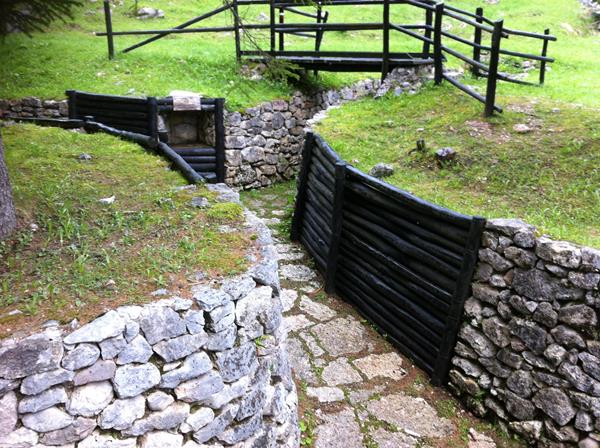
Trenches at the ecomuseum of Great War, on mount Zebio.
Monte Zebio was for the writer “the mountain of home,” reachable in an hour and twenty minutes of walk from its Val Giardini (see itinerary of Sant’Antonio), but easily also by car, with the road that leaves behind the “colonia” which closes the valley going up for about 8 kilometres.
After parking near Malga Zebio (1,670 m), take the path to the east that in a few dozens of metres goes up to Crocetta (1.708 m), where there are restored positions and trenches. From here you go down smoothly with the mule-track to the mine of Scalambron (1,677 m, exploded perhaps due to a lightning on June 8, 1917, killing 120 soldiers of the Catania Brigade who were on patrol because of the impending attack on the Ortigara).Then the refuge Stalder, where there are a rebuilt didactic trench and the evocative military cemetery of the Sassari Brigade (1,575 m), which wrote here with its “Red Devils” one of its most glorious and bloodiest pages.
Returning to the mine of Scalambron, taking the path 832 you can climb to Cima Zebio (1.717 m), reach the Busa del Carbon (1,776 m), then, bending towards north-east, the source of the Albi di Pastorile and the eponymous “casara” (dairy). From here go down south to take the road from Asiago and then go back to the “malga” (hut), in less than two hours.


