

off
Monte Fior – Castelgomberto
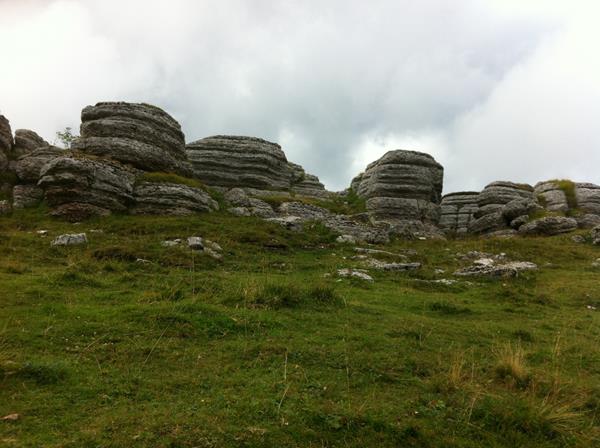
Rock formation on mount Fior.
“Austrians and Bosnians, supported by three hundred and fifty guns, attacked the Nodo delle Melette to circumvent the defenses of Monte Grappa and the Piave line. From there they already saw the Venetian plain.
Monte Fior, Castelgomberto and Tondarecar were boiled up by cannonades, and later, battalions after battalions of Austrian and Bosnian soldiers moved into the attack. Machine guns, gunshots, grenades, bayonets, hand-to-hand (…) Enrico Busa managed to live until December 5. This man who loved life, friendship and good company; who as a civilian was the town clerk in one of the subalpine communes of ours, this man fell fighting like a lion after days of the hardest struggle, together with a few Alpini, survivors of so many battles.
Looking around southwards he saw Bassano, the Marostica hills, the Colli Berici and Colli Euganei, the Brenta river until the Lagoon and Venice. He fought for friends, for the loved women who were there, for the good wine of Fara. For him, Fatherland was a too abstract concept. So he died, and his body was one of the many without a name, in the pile of Malga Lora…”
From “Aspettando l’alba” (Waiting for the Dawn), “La bottiglia ritrovata” (The recovered Bottle)
The context
In this short story Rigoni Stern reconstructs the events of a bottle of “grappa” (the typical Venetian brandy) brought to the front by a young Piedmont’s lieutenant in the area of Boscosecco, and then forgotten in a ravine in autumn 1917, at the time of the Caporetto’s retreat. The boy died a few days later on Monte Fior, along with his captain, Enrico Busa, and thousands of soldiers on both sides. Albino Vù was the one who recovered the bottle thirty years later, and drank it with the writer returning from hunting. He was the old “recuperante” (a man who works retrieving war remnants) to whom it was inspired the Ermanno Olmi’s film “I recuperanti” (The Retrievers), on which both Rigoni Stern and the film critic Tullio Kezich worked together. Olmi and Kezich built their homes close to that of the writer, in Val Giardini. In the passage proposed here, there are echoes of two books that Rigoni Stern loved very much: “Le scarpe al sole” (The shoes in the sun) by Paolo Bonelli, and especially “Un anno sull’Altipiano” (A year on the High Plateau) by Emilio Lussu, whom Rigoni Stern considered the best of those on the Great War. Rigoni Stern knew whole pages of the Lussu’s book by heart. It is the moment of maximum advance of the Austrians in June of 1916, and from Monte Spil Lussu describes the occupation of the ridges of Monte Fior, and the excitement among the enemy troops: “I looked back and realised. In front, all lit up by the sun, like a huge blanket covered with sparkling pearls, lay the Venetian plain. Below, Bassano and the Brenta; and then, right at the bottom, Verona, Vicenza, Padua and Treviso. At the bottom left, Venice. Venice!”
The route

Mount Fior (ph: Sergio Dalle Ave)
There are three excellent paths of the CAI (Italian Alpine Club) to reach this place, very interesting for the historical aspect (during the war this area was called “the key of the plateaus”), as well as for landscape and nature (the peculiar rock formations known as “città di roccia,” cities of rock, the landscape described by the writers, the presence of moufflons and marmots). These paths start from the road which from Asiago and Gallio leads to Foza and Enego. The first – the no. 858 – climbs the slope of Melette di Gallio starting from the forest road, 500 metres after Contrada Campanella (1,034 m), until reaching the area of Malga Slapeur (1,606 m); here comes also the second path – the 861 – which instead runs through the Val Miela. You can use it for the descent, returning to the provincial road one and a half kilometres after the starting point, and after five hours of walking. Finally, the path 860 runs through a loop that from Cruni (1,088 m), north of Foza, takes the road of the Futa and then leaves it to climb up the Val Vecchia until reaching the locality Kemple (m. 1,576), where it joins the dirt road that from Fratte, leaving the Monte Tondecar on the right, reaches the small war cemetery and then Malga Lora. You can get here, however, also by car, going past Foza and taking the paved road that from Lazzaretti, on the road for Enego, goes up to Malga Fratte, where you have to turn left onto the dirt road. After passing the “malga,” the road goes gently up the eastern slope of the Spil up to the fork at 1.769 m, from which the trail descends to Casara Meletta and then through meadows and woods along the hairpin curves of an old wartime mule road it reaches the starting point, after about four hours of walking.
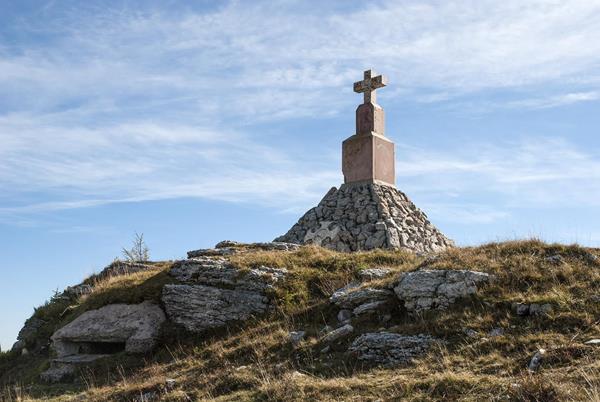
Monument to the Gen. Euclide Turba (ph: Sergio Dalle Ave)
The junction, however, is also the ideal starting point to explore the peaks of Monte Fior (1.824 m) and from there to reach Monte Castelgomberto (m. 1,771), following the path 861. The panels of the Eco (and various stones and plaques) illustrate the various stages of the war and lead to the trenches and emplacements in the caves, partially restored. On the Castelgomberto stands a chapel dedicated to the general Euclide Turba, who fell here in 1917 at the head of his men: from here a splendid panorama over the plain of Marcesina. At the saddle the trail continues to the west around the Torrione and reaches Malga Slapeur, with the monument to the Bosnian soldiers, then, cutting off the west side of the Fior with the formations of the “Città di roccia” (Cities of rock), it arrives at Casara Mountain Nova (1,724 m), from where a deviation to the right goes down to the spectacular observatory (1.625 m). From the Casara, heading to the north the ring closes smoothly finding again the path 860 and the road to Malga Lora.


