

off
The four houses
“My house, the house where I was not born, and which the ancestors had built five centuries ago, was at the centre of the village and cornered a road linking the northern streets to the square… The house was not large, because it was one of the first built with bricks after those in timber, burnt in 1447 by the soldiers of Sigismund of Austria. The rooms were low, with wooden ceilings, except above the ground floor where there were stone vaults. Over the three floors, the roof was very steep, covered with shingles and without chimneys (…)”
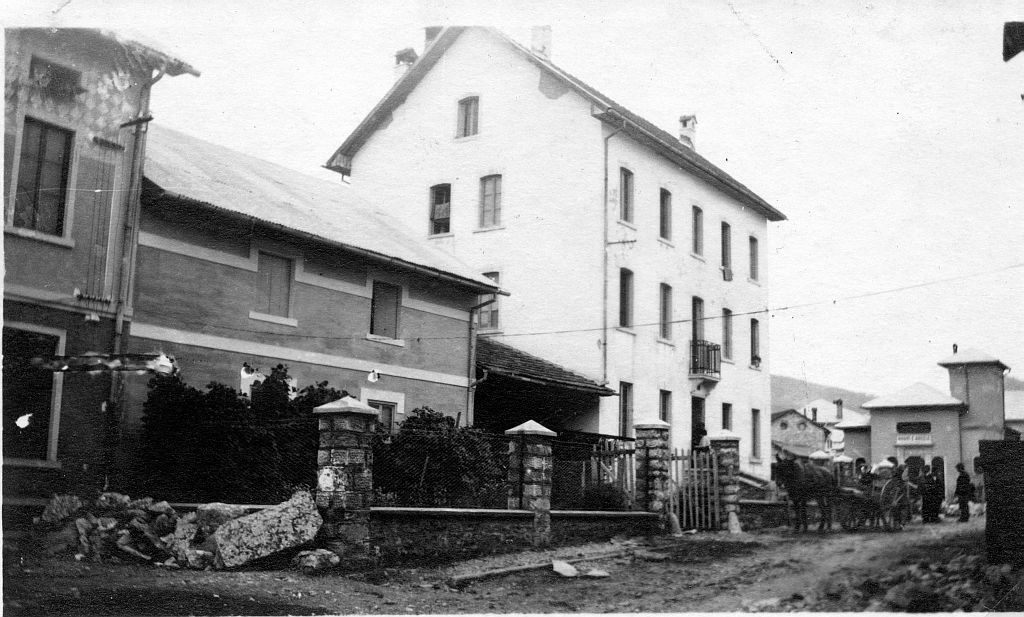
The birthplace house of Mario Rigoni Stern
“They even rebuilt the more modern house that in 1910 my grandfather wanted less than a hundred metres from the old, and it was here where I was born. A house in the middle between the old and the new. There were really buckets of copper, but also the sink with the tap, really bronze and earthenware pots for the fireplace, but also pots for the kitchen range collected in a walnut dresser (…)”
“My third house was a refuge of the unconscious, and physically I’ve never dwelled in it. After years of war, I found myself in a great Lager, in a very sad corner of East Prussia (…) On a sheet of paper found somehow, meticulously and patiently I drew the house I’d built on my return (…)”
“Today, after years of work, I have made a house designed and built by myself; and it is as simple as a hive for bees (…)”
From “Amore di confine” (Border love), “Le mie quattro case” (My four houses)
The context
In this short story the writer lists the most important houses of his life, omitting some others, such as those in Piazza Carli or in Val d’Orco. Describing them in detail, Rigoni Stern let us know (in detail) what the life was that of a middle class family in Asiago was in the nineteenth century and in the first half of the twentieth century respectively, and he recalls his life as a child who, searching in an attic or in a basement, found the elements – from horse saddles to a rifle or a piece of glider – to give free play to his young imagination.
The places
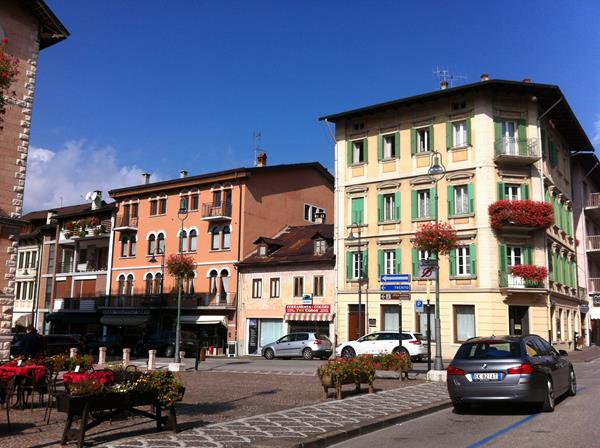
the first house of Mario Rigoni Stern (white, on the right) and the one in which he wrote “The sergeant in the snow” (orange, on the left).
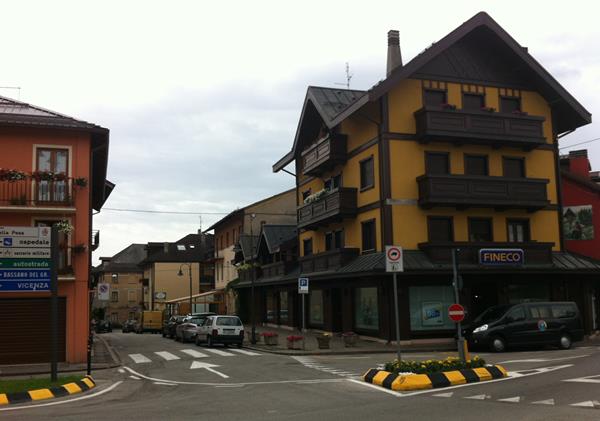
Ortigara Street today.
The first two houses described in this short story are in the centre of Asiago: the grandparents house and shop, which guarded the so-called Kantàun vun Stern, the Sterns’ Corner, where Via Dante leads into Piazza II Risorgimento. In the photo is the house on the corner, raised and remodeled in the 60s. In the orange one with arched windows, partly built by his uncle “Barba” of the short story “Vecchia America” (Old America), the author instead lived with his family from 1949 to 1956, and here “The Sergeant” and the early stories saw the light. The second house, now replaced by an apartment building, was located in via Ortigara, in the corner of Piazza della Pesa. Also the end of “Che magro che sei fratello” (How skinny you are, brother, in “Sentieri sotto la neve”, Paths in the snow) refers to this street; this is the intense story of his return home after war and captivity. He dismounted from a truck of partisans that had stopped at the Albergo Croce Bianca (Hotel of the White Cross), along the avenue, and then he painfully covered the few tens of meters that separated him from his home, finding the courtyards, gardens, trees, doors. “It was the longest of all the streets,” he writes, “the most difficult to find, the most beautiful street of the Earth, of all the streets that he had walked.”

The house in Val Giardini, that Mario built with his own hands, with his sons and a group of bricklayers, and where he lived until his last day.
His last home, the one where he died on June 16, 2008, is placed instead in Val Giardini, and the writer built it by himself, with the help of his sons and only at a later time of some masons.


