

off
La Piazza
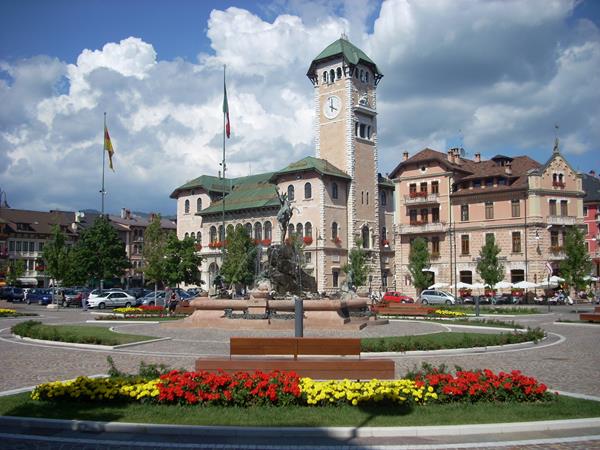
The gardens of Piazza Carli in Asiago (ph: Iat Altopiano di Asiago)
“They had rebuilt the town by then, with just a few shacks left standing. The new town hall, all done in pink marble, was waiting for Prince Umberto of Savoy to perform the opening ceremony. And the six new bells were waiting, too, on logs by the church doors, for the bell tower to be finished so they could be hoisted up to the belfry (…)
A few days before the Patron Festival of Saint Matthew the Apostle, the bells were hoisted up the bell tower – and they really were “hoisted” – it took winches, tackle, pulleys, ropes, all provided by the Masain Brothers, and with the whole town gathered together for one big tug-of-war to get them up there. Even the school boys were invited to join in alongside their teachers. The bells had been set at the base of the tower; one by one they were tied, then raised on a very long, thick rope running a pulley rigged up in the belfry. People formed a long line starting at the bell tower, past the Sterns’ shop, up Mezzacavalli Road, to Croxebech.
From “Giacomo’s seasons,” translated by Elizabeth Harris, Autumn Hill Books, 2012.
The context
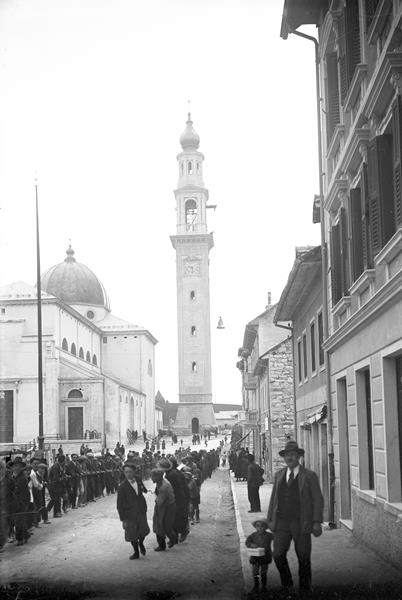
The people of Asiago engaged in the lifting of the bells, in September of 1927.
We are in September 1927, and in the first pages of his “Bildungsroman” Mario Rigoni Stern introduces his friend James and himself, both six years old, working together with other villagers to pull the rope to lift the bells of the new bell tower. It’s a passage that refers to another belonging to “L’anno della vittoria” (The year of the victory), when Matteo and his father found a fragment of the old bells in the rubble of the tower (see the itinerary of the Val d’Assa). The town has hardly begun to live again, even if the memory of the war, the escape and the first very hard years of reconstruction living in barracks is still very much alive.
The place
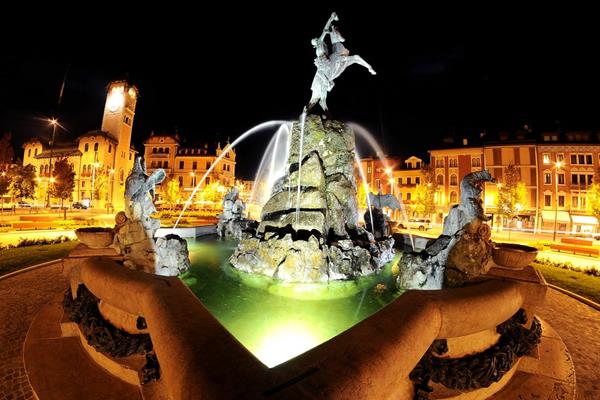
The Fountain of the faun (ph: Roberto Costa Ebech)
The central square of Asiago at the time had almost taken the present structure. To the east, designed by the Venetian Vittorio Invernizzi, there is the Town Hall, which works began on July 6, 1924 with the laying of the memorial foundation stone (on which was carved the phrase “Ex igne splendidor,” motto of the reconstruction) and would be completed in 1929. On the west side there is the Duomo, church dedicated to the patron Saint Matthew, rebuilt on the site of the ancient church of the 14th century, and opened in 1926. The south side of the church since 2003 houses a copy of the ancient sundial with different systems of time measurement (Italic and Babylonian) and a Cimbrian inscription which means “I’m silent when the light is missing, but when I speak I tell the truth.” To the south of the Duomo, finally, in the same years was built the fountain of the faun, the deity of countryside and woods, at the centre of the gardens.


