

off
Sant’Antonio (St. Anthony)
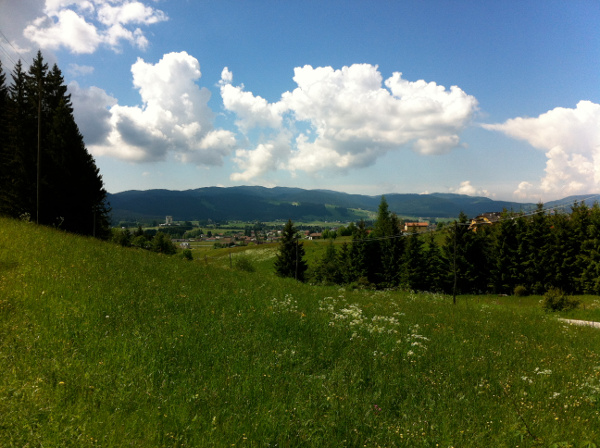
Asiago seen from Sant’Antonio – Valgiardini
“Each morning, when there was enough light along the gravel muletracks, the silent line of recuperanti would climb up to the trenches. The men’s footsteps on the stones sent the hares into hiding. The nightjar snickered, then settled down to sleep. Giacomo went, too, with his friends from the nearby districts: the Pûnes, the Grasses, the Vuzes, the Sechs, the Ballots, the Càstelars”.
From “Giacomo’s seasons,” translated by Elizabeth Harris, Autumn Hill Books, 2012.
“The road went up along the back of the old moraine the centuries have covered with woods. A rustle of wings made me raise my head to the sky where a pair of ravens flew high up the mountain (…) So, looking beyond the valley, I saw the rock, too, where I knew to be a small herd of chamois (… ) At the edge of the road every now and then I saw the beautiful flower of the foxgloves, the precious plants that in the past have healed so many hearts (…) Watching the foxglove my eye lingered on something dead. I bent down to pick it up. It was a little bird, a chick probably killed yesterday evening by the hailstorm (…) It did not have the time neither to fly nor to sing. I left it in the undergrowth: it will become humus too. It will live again in a flower.”
Da “Tra le due guerre” (Between the two wars), “Amore e morte nel bosco incantato” (Love and death in the enchanted wood).
The context
In the first passage, Rigoni Stern tells the epic story of the “recuperanti”, who for many years, between the two World Wars, but also after the Second World War, combed every inch of the battlefield in search of war remnants to resell. Epic deed to which also the eponymous 1970 film, directed by Ermanno Olmi on a script by the same director, Mario Rigoni Stern and Tullio Kezich, is dedicated.
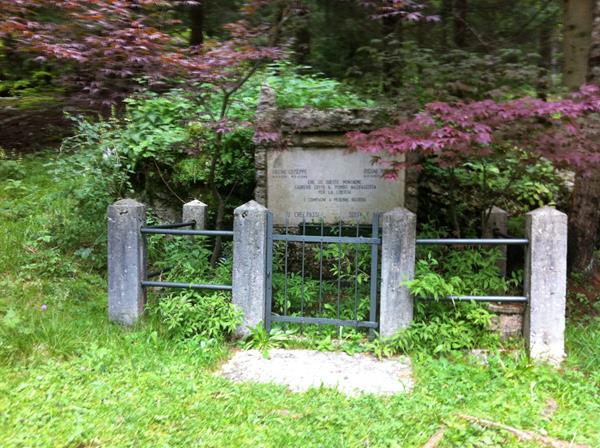
Monument to partisans.
The roads and paths traveled here by the father of Giacomo and his companions are also mentioned in “Storia di Tönle” (History of Tönle) and “L’anno della vittoria” (The Year of Victory), and were the ones closest to the house of the writer, who walked on them almost daily, especially before the sunset, after having finished writing.
Leaving the Val Giardini and the cross at the edge of the wood, alone or with his dog he climbed up the slope of the Puntareche (detailed description in chapter 12 of “L’anno della vittoria”) to the plaque commemorating the partisans killed on the Isidoro, including Moretto (see the Malga Fossetta route), sometimes reaching the Altebene plateau, where the young protagonist of “Le stagioni di Giacomo” (the Seasons of James) goes to gather firewood in the fall of 1930. Other times he took to the right, climbing along the road of Sant’Antonio (St. Anthony), as told in the second passage, particularly significant because it perfectly illustrates his way to walk, careful to “read” every sign of the land, in complete harmony with nature.
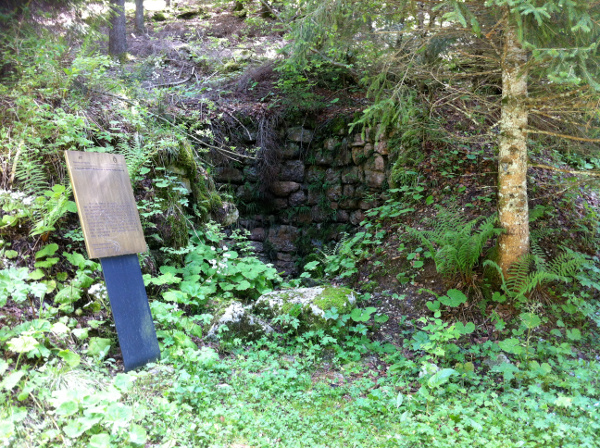
The old limekiln.
Along the same road, at an altitude of 1,300 metres, there is a limekiln, as described in “Uomini, boschi e api” (Men, woods and bees). “They are cylindrical structures in the open air, between three and six meters high, a diameter of four or five steps, completely empty,” constructions in which until the Fifties stones were baked to make lime.
The route
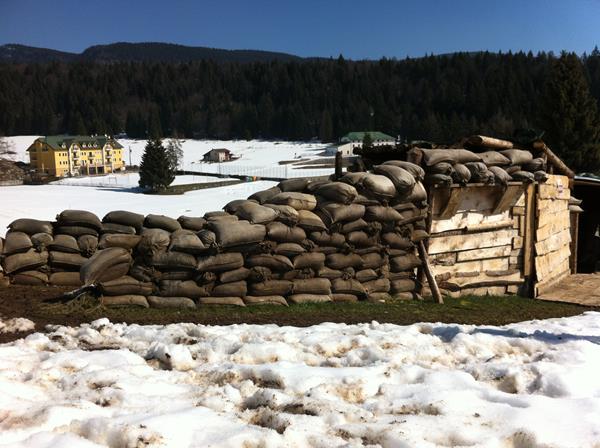
The trench reconstructed for the film “will return the meadows” by Ermanno Olmi, dedicated to the Great War.
From the junction of Val Giardini, before the Colonia, turn left onto the dirt road (CAI path 832B) leading up to the Monte Zebio through Puntareche, the monument to the partisans, the Altebene (45 minute of smooth climb). At the junction with the forest road leave the path that leads to the cemetery of the Sassari Brigade and the Zebio, and go down on the right along the street for about 200 m, until the first curve to the left, where you turn right into the unmarked path through the forest that reaches after about 300 meters the valley below the road to San Antonio, where there is the old limekiln. Then climb to the carriageway, and come down to 3 km to Cologne and to the starting point.


