

off
Osteria “Al Termine”

The “Osteria all’Antico Termine”
“It is so quiet now! It is the moment when the wood around makes you feel the sigh of the wind that moves the branches waiting for the snow.
That night, when the innkeeper and his wife will leave the Osteria, with the large attic, unadorned rooms, corridors and even roads from far away, the spirits will gather in front of the fireplace – it has always been the same for centuries, the only artifact left after wars and fires! – where there is the fire that does not consume; as they do not consume the oil that feeds the lamp, and wine and grappa, bread and cheese.
The wooden chairs with straw bottom will be occupied by the first ones who come near the fire. It may happen that the field marshal Baron Franz Conrad von Hötzendorf sits down on the hearthstone and the smuggler Tönle on the comfortable chair, that Musil remains standing leaning against the frame of marble, General Count Luigi Cadorna next to Tönle, and Barba Matio, only for pleasant habit, cure the fire and its pipette. They will talk about their past life, the great facts and many other things. All, more or less, have dealt with this bordering Osteria.”
From “Sentieri sotto la neve” (Paths under the snow), “Osteria di confine” (Boundary Inn)
The context
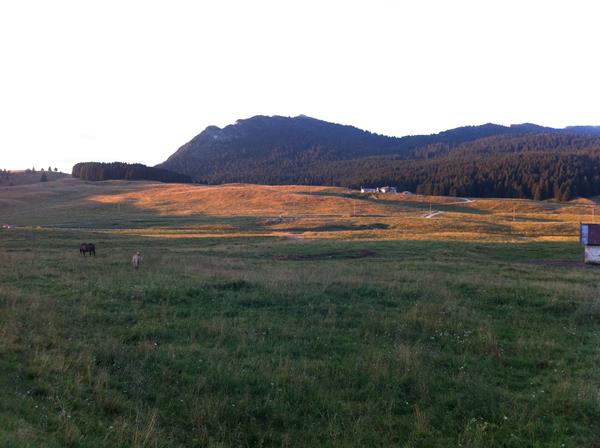
Vezzena plain with view of Spitz Verle.
The high Val d’Assa is the main link between the Plateau and the Trentine, and for centuries the “Termine” was not only the border between two regions – and between 1866 and World War I two states, Italy and the Austro-Hungarian Empire – but the first door that opened to the Germanic world.
Rigoni Stern recalls, in this and other short stories, as well in “Amore di confine” (Border love), that where the Osteria is now, already during the plague of 1631 a shelter in logs for the Health Guard was built, which controlled who entered the territory of the seven municipalities. And here the patriots gave convention against the Habsburg in 1848. The “Termine” (where the wonderful short story “A Christmas of 1945” is also set) was also the obligatory stop of the many seasonal migrants who from the Plateau reached the lands of the Empire in search of work. The writer also reminds it in “Storia di Tönle” (Story of Tönle): “By that time many went to work outside the borders of the State; they left in spring, in groups, with the tools of their work in the wheelbarrow and walked through the Asstal and Menador to Trento, where those who had the money could also take the railroad. Sometimes, these groups also accompanied the boys who had just finished elementary school, and the border guards of the Termine, of both sides, let them pass without any formality…”
The inn, formerly the seat of the Italian Commands, after the Strafexpedition housed the emperors Franz Joseph and Charles I of Habsburg in their visits to the front during the Great War. Also fought in the vicinity Fritz Lang, to whom the writer made meet Tönle on the way to escape, Robert Musil and Fritz Weber.
In his story Rigoni Stern imagined a meeting of minds, more or less famous, real or literary, gathered there in intense discussions about history, war and the suffering of peoples. The same author will join them as well, in a future dream…
The route
The Osteria is located in a clearing, at the km 35 of the provincial road 349, 12 kilometres from Camporovere and 5 from Passo Vezzena. It is open from Easter to early November, and offers a menu of homemade dishes at popular prices. Nearby there is a war cemetery, and in front of the inn flows the Assa stream, who springs on the nearby, sunny plain of Vezzena. This is the ideal place for cross-country skiing, and the starting point to visit the forts Verle (1,504 m, immortalised in the pages of Fritz Weber and Luis Trenker) and Spitz Verle (1,908 m), which offers spectacular views of the lakes of Levico and Caldonazzo and a large part of the Asiago Plateau.


