

off
Piana di Marcesina

The plain of Marcesina (ph: Sergio Dalle Ave).
“But will there still be lovers that in a winter’s night get carried on a sled pulled by a generous horse through the plain of Marcesina soaked in moonlight? If they were not, how sad the world would be”
“Mostra di antiche slitte” (Exhibition of old sleds), catalog, Marcesina, July-October 1991
“After going through the Ech del Bolf you stopped at the church of San Lorenzo, all built in wood, in the centre of the Merck-wisen, where shepherds, charcoal burners, herdsmen and woodcutters had gathered for the mass. You observed all those faces absorbed in prayer and, later, you sat with them on the meadow to have a snack. Then through the Kamull, Fiara and Nostal you walked up to Asiago…”
From “Aspettando l’alba” (“Waiting for the Dawn”), “Lettera a Jacopo” (Letter to Jacopo)
The context

Dawn at Marcesina (foto: Roberto Costa Ebech).

The plain of Marcesina in winter (ph: Roberto Costa Ebech).
Marcesina is a large and fascinating plain in the north-east of the Asiago Plateau, at an altitude of 1,400 metres, mostly pasture for cows, crowned by thick forests of firs and peaks of modest height, that however in the north plunge in Valsugana with a vertical drop of more than a thousand feet. The special feature of the plain is that its shape favours water deposit, which forms pools and bogs rich in rare flora species, such as the “carnivorous” Drosera rotundifolia or the poisonous Andromeda polifolia. The same geography determines the phenomenon of the temperature inversion, with the stagnation of denser cold air at the bottom of the basin, which not coincidentally is, in winter, among the coldest places in Italy. The plain was inhabited since prehistoric times, as evidenced by the archaeological site of Riparo Dalmeri (north of the plain, above Val delle Agnelle, dating back 13 thousand years ago) and Grotta dell’Ernesto (bones of animals slaughtered 9 thousand years ago, no longer open to visitors).
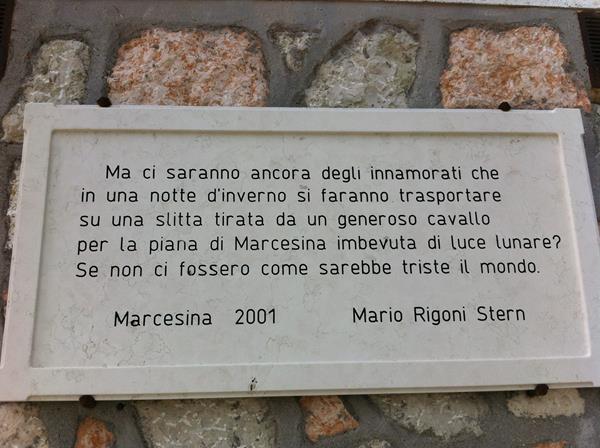
A stone plaque at the Marcesina Hotel, with words writte by Mario Rigoni Stern.
The first quoted passage appears in a plaque on the wall of the Albergo Marcesina hotel, and reports the final sentence of the preface written by Mario Rigoni Stern to the catalog of an exhibition organised by Maria Teresa and Ivo Baldisseri, owners of the Albergo Marcesina and a museum of sleds in Carmignano di Brenta (Padua).
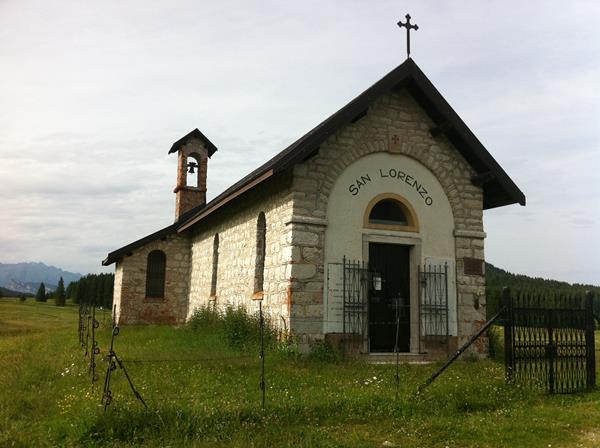
The little church of St. Lorenzo, in Marcesina.
The second passage is taken from an amazing short story written in the shape of a letter to the painter Jacopo da Ponte (1510-1592), whom the writer defines neighbour and “brother.” Rigoni Stern reconstructs the painter’s life and the relationships with the land of origin of his family, the Asiago Plateau, twisting the sensitive description of his paintings with the places in which they were conceived or realised. In the episode mentioned, Da Ponte and his son Francesco go from Enego (where the painter had worked at the altarpiece of the Santa Giustina’s Cathedral, in 1555 or 1556) to Asiago, through Marcesina. The church of San Lorenzo, dedicated to the patron saint of the Plateau’s shepherds against the incursions of the Valsugana inhabitants, was rebuilt after the Great War, and is located a few hundred metres from the Albergo Marcesina, along the path of Sentiero dei Cippi.
The route
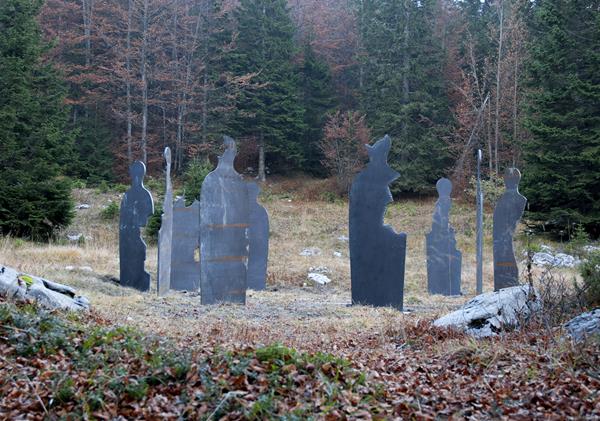
The Path of Silence, in Campomuletto.
In summer, the plain is perfectly suitable for mountain bike, but you can travel by car as well. In winter, you can do cross-country skiing or snowshoeing. The route described here can be done by car, although some stretches of unpaved road will be bumpy. There are many possible lateral deviations to walk. From Gallio you reach the ski resort of the Melette, then Campomulo (where in winter the cross-country tracks start), Campomuletto (to the right of the Sentiero del Silenzio, Path of Silence) and Fiara (gravel road).
About two kilometres further, passed Malga Mandrielle, with a bend to the right you leave the road towards the Ortigara, heading to Malga Buson; in the hairpin curve before the hut turn left towards Rifugio Barricata, from which a paved road goes down to the Valsugana (but blocked however by a no entry at Pria della Messa), and another one goes around Monte Cucco on the right heading for Marcesina, crossing the Sentiero dei Cippi. Before the Albergo Marcesina, on the right, stands the church of San Lorenzo, and a little further west there are the Paludi (marshes), with bogs and protected vegetation.
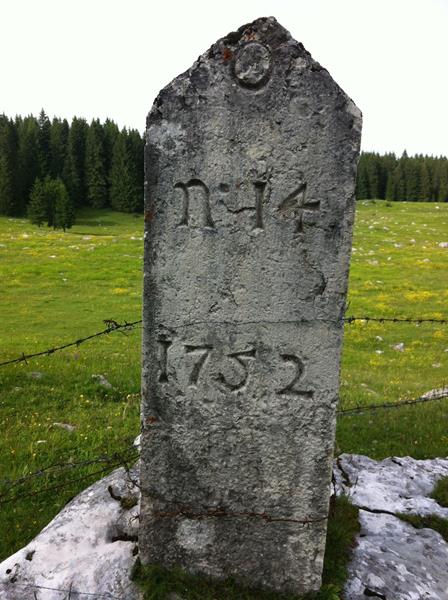
The “Sentiero dei cippi” (path of the boudary stones).
After passing the hotel, in the southern direction you reach, after about two kilometres, the junction of the Rifugio Marcesina, where on the left you go to Val Maron and Enego, while continuing you head towards Malga Ronchetto, the Fratte and the Lazzaretti di Foza hamlet (see itinerary Monte Fior-Castelgomberto). Shortly before Malga Ronchetto a dirt road takes the lonely valley of Campo Cavallo, up towards Monte Sbarbatal; just before the pass a small road on the left leads to the Bosnian cemetery. Keeping going, finally, you take the descending way that joins with the outward road just above Campomulo.
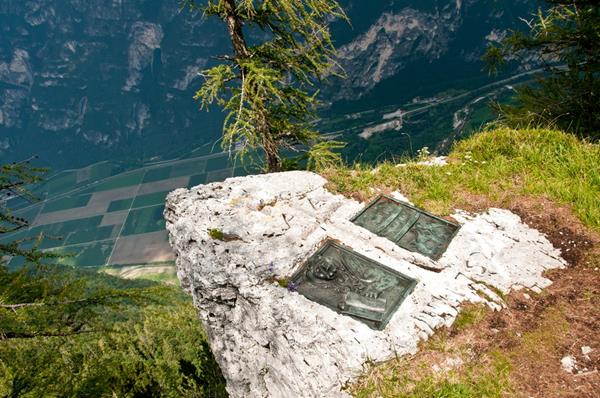
Anepoz, the spur on the Valsugana from where start the “Sentiero dei cippi” (ph:Roberto Costa Ebech)
The aforementioned path of the Sentiero dei Cippi instead retraces the boundary line fixed in 1752 after lengthy negotiations between the Hapsburg Empire and the Republic of Venice. The CAI drew a path (no. 869 and no. 869B) that heads off from Località Frizzon (3.5 km from Enego) and reaches the milestone no. 1 known as Anepoz (anvil), which is vertically over the Valsugana, close to the Castelloni of San Marco, returning to the starting point in a nine-hour walk (it is recommendable to split the journey in two days).
On the places of Jacopo da Ponte and his paintings we suggest an itinerary developed by the Consorzio Vicenza.


